

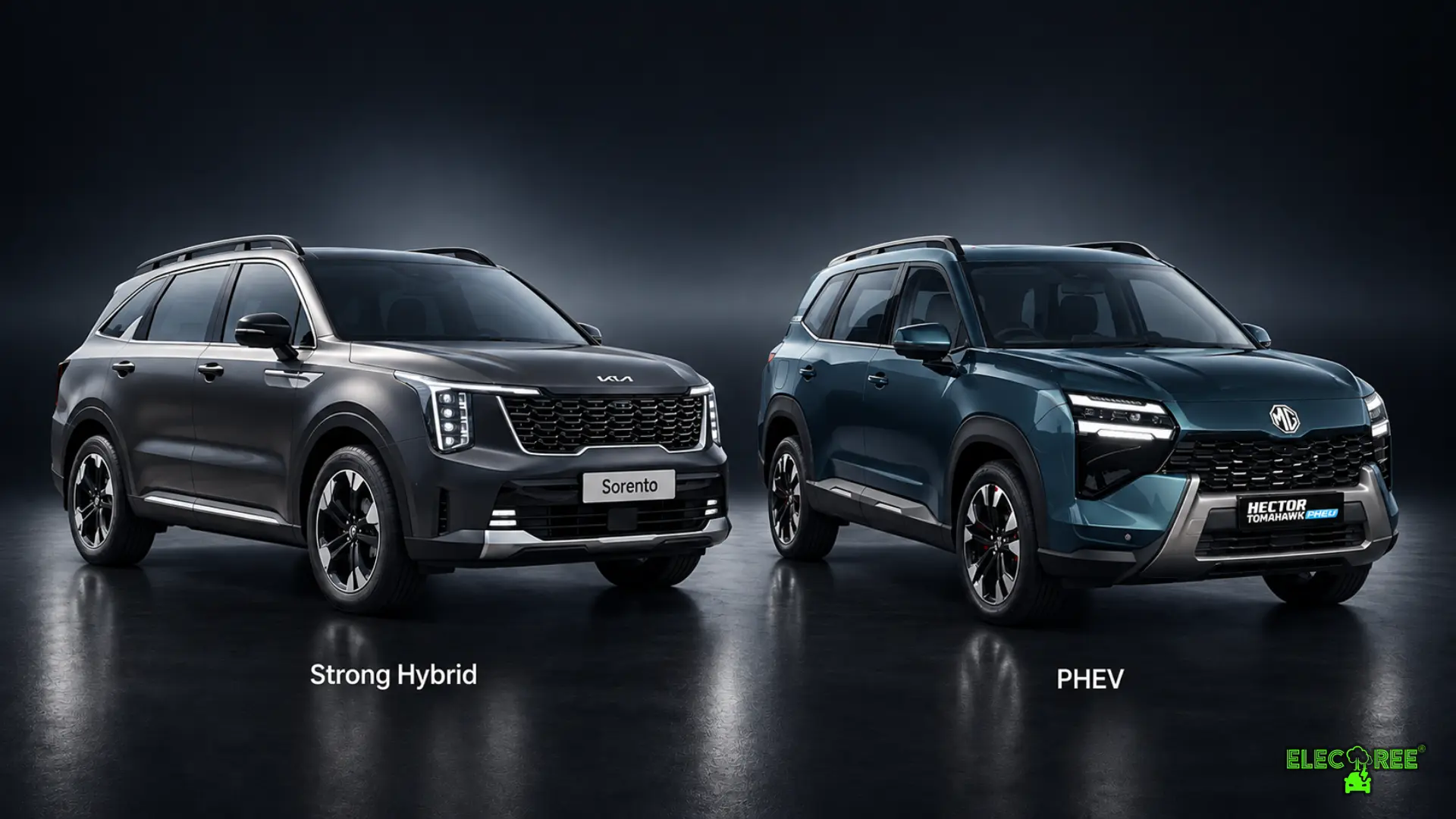
The MG Hector Tomahawk PHEV launched in India on August 26, 2026. The Kia Sorento followed on September 4, 2026, with a strong hybrid powertrain. Both cars have a petrol engine, an electric motor and a battery. Both are considered as hybrids, plug-in and strong respectively. But the Sorento's battery is smaller than the one in many electric scooters, while the Tomahawk's is as large as the pack in some early electric cars. That difference is not a spec-sheet detail. It decides what the car actually is.
Why a Hybrid Exists
A petrol engine is efficient only in a narrow band, roughly moderate revolutions or revs, at fairly high load. City driving keeps it outside that band most of the time. At a red light the engine idles and does nothing useful. At crawling speeds it runs at a small fraction of its capacity. And every time the driver brakes, the energy that was moving the car is turned into heat at the brake discs and thrown away.
An electric motor is the opposite in every one of these situations. It is efficient across almost its whole operating range. It gives full torque from zero revs. And it can run backwards as a generator, turning the car's motion back into electricity when slowing down.
A hybrid pairs the two so that the engine runs only when it can run well. The motor covers the situations where the engine is wasteful. The battery is the place where energy is parked between the two.
What Is Inside a Hybrid
Every hybrid has four core parts. There is a petrol engine, usually tuned for efficiency rather than outright power. There is a traction motor that drives the wheels. There is a generator, which in some designs is a separate machine and in others is the same motor working in reverse. And there is a high-voltage battery, typically in the range of 200 to 300 volts.
A control unit sits over all of this. Numerous times a second it decides which of these parts supplies power, which absorbs it and whether the engine should be running at all.
The Sorento uses a 1.6-litre turbocharged petrol engine with an electric motor built into the transmission, driving through a six-speed automatic gearbox. The Tomahawk uses a 1.5-litre naturally aspirated petrol engine running on the Atkinson cycle, paired with a single electric motor through what MG calls a ‘Dedicated Hybrid Transmission’. On paper these sound like variations on one idea. However they are quite different in how they use the engine.
How a Hybrid Drives Through a Day
The easiest way to understand a hybrid is to follow it through an ordinary drive.
- Pulling out of the parking lot and crawling through traffic, the battery powers the motor and the engine stays off. The car is silent and pulls cleanly from a standstill.
- Under gentle acceleration or steady low-speed driving, the car stays electric as long as the battery has charge and the power demand is low.
- When the driver asks for real acceleration, or the road climbs, the engine starts. Engine and motor now both contribute. The battery adds a burst on top of what the engine alone can deliver.
- At steady cruising speed, the engine runs at an efficient load. If it is producing more than the wheels need, the surplus goes into the battery.
- When the driver lifts off or brakes, the motor becomes a generator and puts energy back into the battery. The friction brakes only take over for hard stops and the last metre or so before standstill.
- At a signal, the engine switches off. The air conditioning keeps running because the compressor is electric and draws from the high-voltage battery.
- And whenever the battery gets low, the engine will run even at low speed simply to recharge it. This is the moment new hybrid owners describe as the engine "running for no reason."
Every hybrid on sale follows this pattern. What separates one from another is how long each stage lasts, and how the engine and motor are connected to the wheels.
Series and Parallel Modes
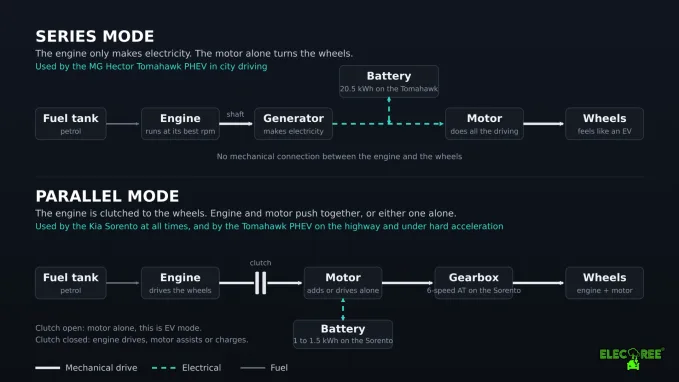
The words series and parallel describe the path that power takes from the engine to the road.
In a series path, the engine is not mechanically connected to the wheels at all. It spins the generator. The generator makes electricity. That electricity goes either to the traction motor, which drives the wheels, or into the battery. The engine is working as an onboard power station. The car always feels like an electric car because only the motor ever turns the wheels.
In a parallel path, the engine has a mechanical connection to the wheels, and the motor sits on the same driveline. Both can push the wheels at once. Either one can push alone. Mild hybrids, the kind with a small motor that can only assist and never drive by itself, are purely parallel. That is why a mild hybrid cannot move on electricity alone.
A strong hybrid or a plug-in hybrid can use both paths, but not every design uses both.
The Sorento's system is a parallel design. The motor sits between the engine and the six-speed automatic, with a clutch that can disconnect the engine. When the clutch is open, the motor drives the wheels on its own. When the clutch is closed, the engine drives the wheels and the motor adds to it. The battery is charged the same way. At cruise the engine runs at a slightly higher load than the wheels need, and the motor absorbs the surplus as a generator. Braking adds the rest. What the Sorento does not do is run the engine purely as a generator while the motor alone drives the wheels, which is the series mode found in the Tomahawk.
The Tomahawk's system has four modes according to MG: pure EV, series hybrid, parallel hybrid, and engine direct drive. In town it runs series, with the engine charging the battery while the motor drives the wheels. At highway cruise the engine is clutched directly to the wheels, because converting mechanical energy into electricity and back again loses roughly 15 to 20 per cent, and at cruising speed the engine is already in its efficient window. Under hard acceleration it runs parallel, with the engine driving the wheels and the motor pulling from the battery on top.
Neither approach is right or wrong. A parallel-only layout is mechanically simpler and works well when the engine is powerful enough to do most of the work. A series-parallel layout lets a smaller engine spend more of its life at its most efficient point.
Strong Hybrid vs Plug-in Hybrid: Battery Power, Not Battery Size
The obvious difference between a strong hybrid and a PHEV is the size of the battery. Kia has not published the battery capacity for the India-spec Sorento, but its global specifications put the pack between 1 and 1.5 kWh. The Tomahawk's pack is 20.5 kWh. That is a difference of well over ten times.
The less obvious point is why that matters, and it is not about how far the car can go on electricity. It is about how much power the battery can deliver at once.
A battery of around 1 kWh can safely push out perhaps 30 to 40 kW. That is enough to move a large SUV gently in traffic. It is nowhere near enough for an overtake at 90 km/h. So the moment the driver asks for real power, the engine has to start. The Sorento's 65 PS motor is sized to match. It is a helper, not the main act.
A battery of 20 kWh can deliver 100 kW or more without stress. The Tomahawk's motor is rated at 201 PS, twice the output of its own 102 PS engine. The motor is the main powertrain and the engine is the backup. That is why a PHEV with a charged battery can hold pure electric mode through hard acceleration and at highway speeds, and a strong hybrid cannot.
This is also why the strong hybrid does not need to be plugged in. Its battery is a buffer, not a store. It absorbs a few seconds of braking energy and hands it back in the next few seconds of acceleration. All the energy in it ultimately came from petrol. The battery just moves that energy to a better moment.
A PHEV has two energy sources. Grid electricity fills the battery overnight, and petrol takes over when the battery is depleted. MG claims 115 km of electric range on the MIDC test cycle. Once that is used, the car settles at a floor state of charge and runs as a strong hybrid, using the same series and parallel logic.
At What Speed Does the Engine Start
This is the most common question about hybrids, and the answer is that there is no fixed speed.
The controller does not look at speed. It looks at how much power the wheels are asking for and how much the battery can currently supply. Speed matters only because the power needed to push a car through air rises with the square of speed. At higher speeds the demand almost always exceeds what a small battery can give.
In practice a strong hybrid will stay electric up to around 40 to 50 km/h under a light foot, and briefly higher when coasting or on a slight downhill. A hard throttle at 15 km/h will wake the engine instantly. The "EV mode" button on these cars only asks the controller to hold the engine off a little longer. It cannot override the limits of the battery.
A PHEV with a charged battery behaves differently because the battery can meet almost any demand the driver makes. The engine starts when the battery reaches its floor, when the driver selects a hybrid mode, or under a very hard throttle where the car wants engine and motor together. Once the battery is depleted, the PHEV's thresholds fall back to something close to a strong hybrid's.
Which Type Suits Which Driver
The two designs answer different problems, and the right one depends on where the car will be charged and how it will be driven.
A strong hybrid asks nothing of the owner. There is no plug, no charger installation, and no change in habit. It delivers most of its benefit in city driving, where the engine would otherwise idle and the brakes would waste energy. On the highway the gain is smaller because the engine would have been in its efficient window anyway. For a buyer with no access to charging, in a flat without a dedicated parking space or a society that has not wired its basement, a strong hybrid is the only one of the two that makes full use of its hardware.
A PHEV is a different proposition. With a home charger and a daily commute inside its electric range, the engine may not start for days. The owner gets the silence, the instant torque and the low running cost of an electric car, with the petrol engine as a backup for the long drive. Without a home charger, the same car is carrying 200 to 300 kg of battery it rarely uses. Its fuel economy in sustain mode will be no better than a strong hybrid's, and often a little worse because of the weight.
There is a widely held view that PHEVs act as a bridge to full electric cars, because the owner gets used to plugging in and driving electric without giving up the fallback. That is plausible. It is also unproven in India. In Europe, where PHEVs were sold in large numbers with tax incentives, a significant share of owners rarely charged them and real-world fuel consumption was far higher than the rated figures. India does not have the same incentive structure, so the pattern may differ. But the transition benefit exists only for owners who actually charge.
The Case Against Both
Both designs carry two powertrains, and both carry the cost of that. There are more components to service, a high-voltage system that needs trained technicians, and a battery whose long-term life is a real question for a second owner.
The PHEV adds to that list. Its larger battery spends more time at a high state of charge, which is the condition that ages lithium-ion cells fastest. Its engine can go weeks without running if the owner charges diligently, which is why PHEVs periodically force the engine to run to keep fuel fresh and seals lubricated. And its weight penalty is permanent, whether the battery is charged or not.
FAQ
1. Does the engine in a hybrid charge the battery or drive the wheels?
Ans: Both, depending on the design and the moment. In series mode the engine only turns a generator and the motor drives the wheels. In parallel mode the engine drives the wheels directly, with the motor assisting. The Sorento uses a parallel layout only. The Tomahawk switches between series, parallel and direct engine drive.
2. Why does my strong hybrid start its engine at low speed sometimes?
Ans: Usually because the battery has dropped to its lower limit and the controller is recharging it. It can also happen when the cabin needs heating, since the engine provides heat, or when the engine has been off for a long time.
3. Can a strong hybrid be charged from a plug?
Ans: No. It has no charging port. All its electrical energy comes from the engine and from regenerative braking.
4. What happens to a PHEV when the battery is empty?
Ans: It does not run out of charge completely. The car holds a floor state of charge, typically 20 to 30 per cent, and from that point runs as a strong hybrid, using the engine and the battery buffer together.
5. Is a PHEV more efficient than a strong hybrid?
Ans: Only if it is charged regularly. On a full battery within its electric range it uses no petrol at all. In sustain mode with a depleted battery, it behaves like a heavier strong hybrid and its fuel economy is similar or slightly worse.
6. Does the "EV mode" button let me drive at any speed on electricity?
Ans: On a strong hybrid, no. It asks the controller to hold the engine off for longer, but the engine will still start when power demand exceeds what the small battery can supply. On a PHEV with a charged battery, EV mode holds across most normal driving including highway speeds.

No comments yet