


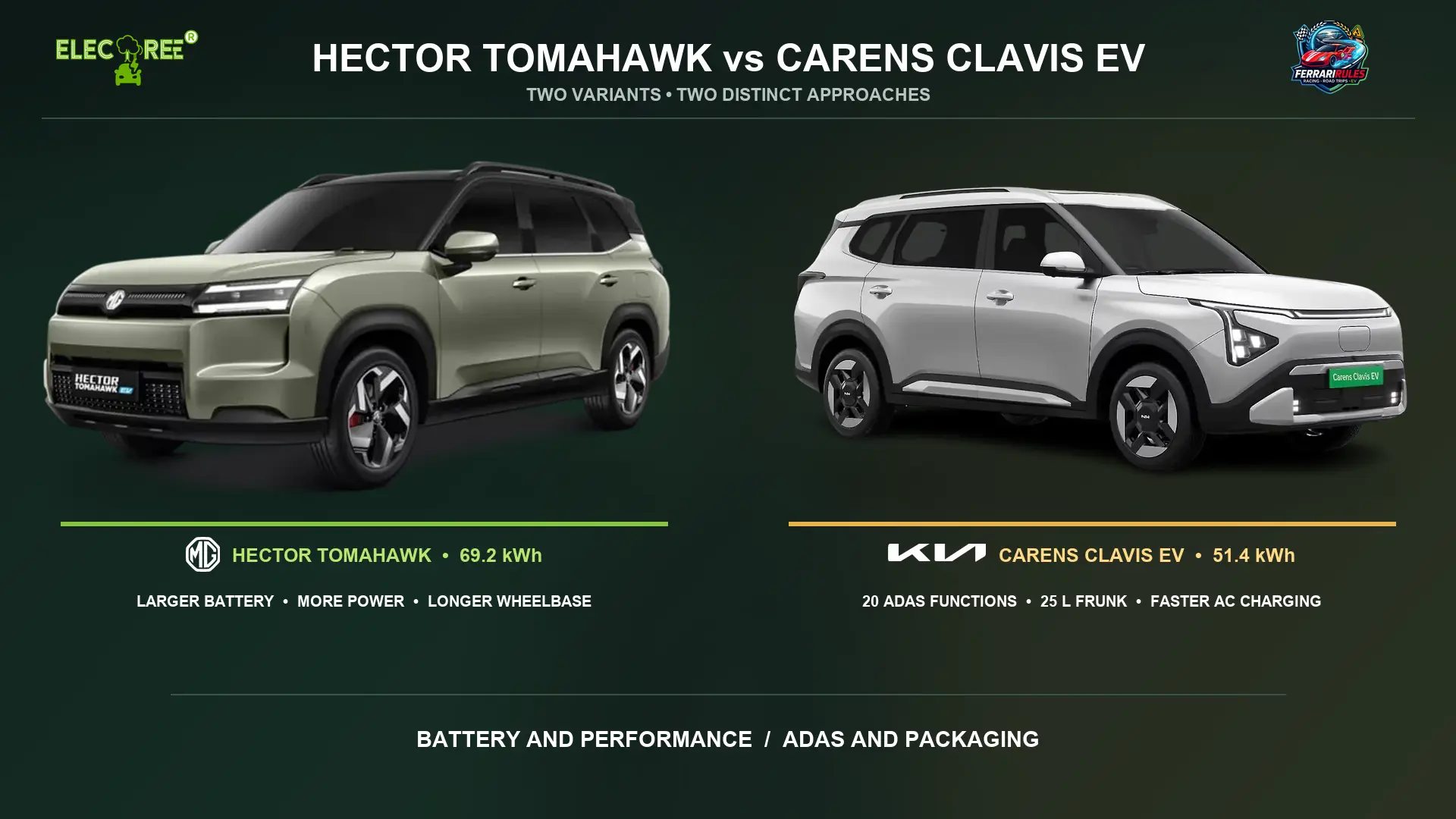
The Hector Tomahawk and Kia Carens Clavis EV approach the electric family-car brief from different directions. The Tomahawk uses its larger battery, stronger motor and longer wheelbase to make the case for performance, space and comfort. The Carens Clavis EV counters with a more compact footprint, a 25-litre frunk, faster AC charging and a broader suite of driver-assistance features.
That difference becomes clearer when you compare similarly priced variants.
Mid variants: only ₹50,700 apart
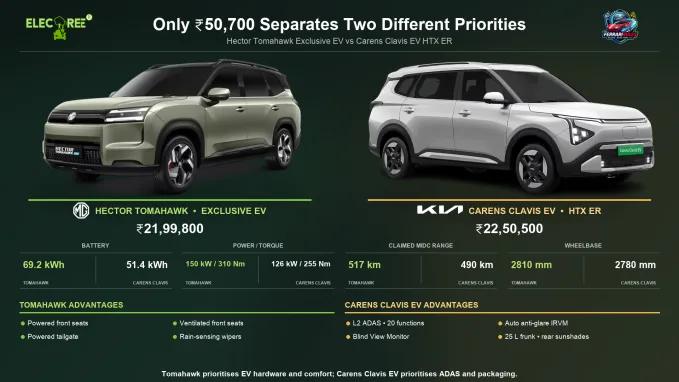
The Hector Tomahawk Exclusive EV is priced at ₹21,99,800 ex-showroom, while the Carens Clavis EV HTX ER costs ₹22,50,500 ex-showroom. Despite the small ₹50,700 gap, their priorities differ considerably.
The Tomahawk has a 69.2 kWh battery against the Carens Clavis EV’s 51.4 kWh unit. It also produces 150 kW and 310 Nm, compared with 126 kW and 255 Nm. Claimed MIDC range stands at 517 km for the Tomahawk and 490 km for the Carens Clavis EV. The MG also has the longer wheelbase: 2,810 mm versus 2,780 mm.
Its variant-specific equipment advantages include powered front seats, a powered tailgate, ventilated front seats and rain-sensing wipers.
The Carens Clavis EV focuses more strongly on assistance and packaging. It gets Level 2 ADAS with 20 functions, Blind View Monitor, an auto anti-glare inside rear-view mirror, rear sunshades and a 25-litre frunk.
Top variants: capability versus technology
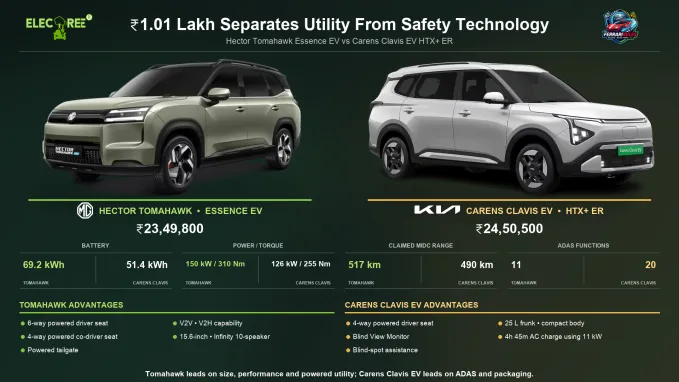
At the higher end, the Hector Tomahawk Essence EV costs ₹23,49,800 ex-showroom, and the Carens Clavis EV HTX+ ER costs ₹24,50,500 ex-showroom—a difference of ₹1,00,700.
The Tomahawk retains its battery, power, torque and claimed-range advantages. Its equipment case includes a six-way powered driver seat, four-way powered co-driver seat, powered tailgate, V2V and V2H capability, a 15.6-inch infotainment display and a 10-speaker Infinity audio system. V2H requires a compatible unit sold separately and is subject to availability; V2V and V2H operation also depends on compatibility and applicable conditions.
The Carens Clavis EV HTX+ ER offers a four-way powered driver seat, Blind View Monitor and blind-spot assistance. It also has 20 ADAS functions against 11 on the Tomahawk, along with the 25-litre frunk and an 11 kW AC charging system. Both vehicles offer V2L, so the Tomahawk’s differentiators here are V2V and V2H.
Which one makes more sense?
The Hector Tomahawk makes the stronger case for buyers prioritising battery capacity, motor output, claimed range, wheelbase and powered comfort features. The Carens Clavis EV is better suited to buyers who value a compact family-friendly package, a useful frunk, faster AC charging and a wider ADAS suite. Carens Clavis EV is known to have high efficiency numbers, so it can extract more from a smaller battery pack.
There is no universal winner here. At both price points, the better choice depends on whether the buyer places greater value on EV hardware and comfort or on driver assistance and packaging.

No comments yet