

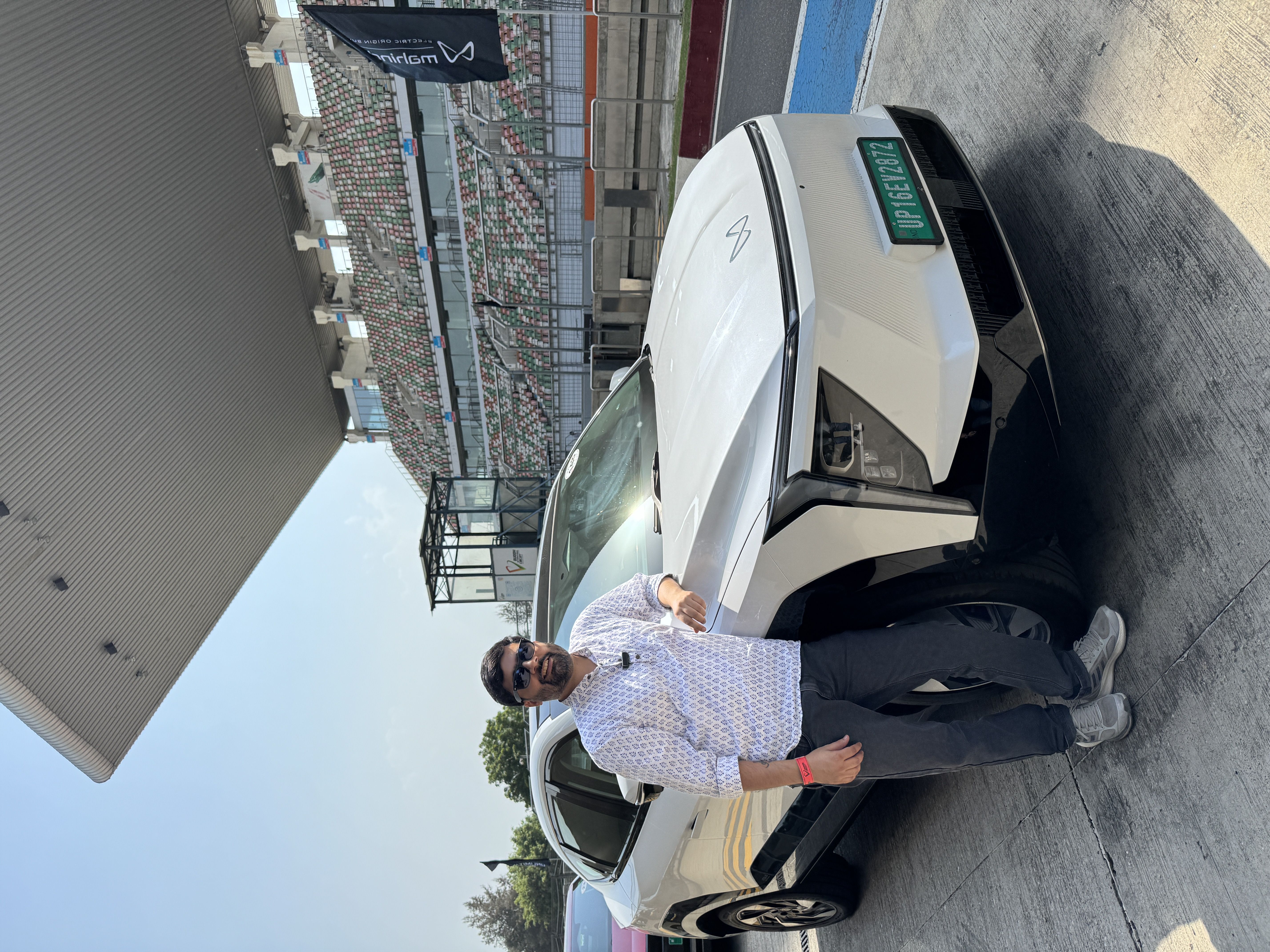
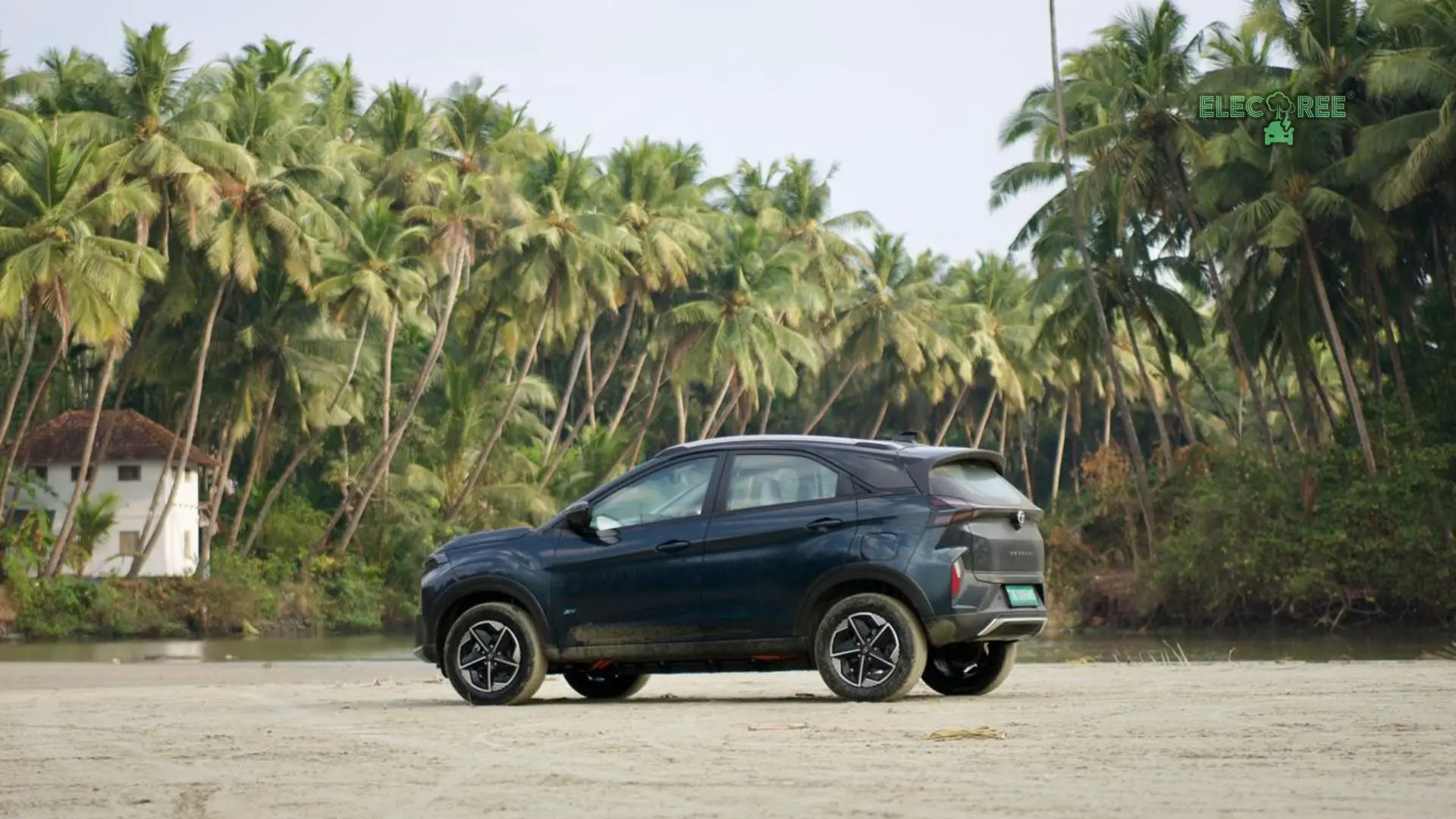
When Selvakumar D shared a detailed breakdown of his Tata Nexon EV 45 ownership on X — 300 days, 70,766 km, ₹4.75 lakh saved — it caught our attention immediately. ElecTree reached out to him to cover his story in full. Selvakumar agreed, and what follows is his honest, data-backed account of owning India's most popular electric SUV as a high mileage user.

Selvakumar co-owns a multi-brand car workshop in Coimbatore. He is not a first-time car owner or a light commuter — he also owns a Volkswagen Jetta diesel, clocked over 2,65,000 kms in his Hyundai Grand i10 petrol and has a professional understanding of vehicles that most owners do not. When someone like Selvakumar says an EV saved him ₹4.75 lakh, the number carries weight.
The Numbers

Selvakumar's Nexon EV 45 kWh has covered 70,766 km over 300 days — of which 35 days were spent on a Europe trip, making his actual driving period 265 days. His daily usage averages around 220 km, split between city driving and intercity travel. This is not light use. Most EV owners in India drive a fraction of this.
His total ownership cost over this period breaks down as follows:
- Home charging consumed approximately 9,250 units, adding ₹72,875 to his electricity bill at an average of ₹7.88 per unit — translating to ₹1.03 per km from home charging alone.
- Public DC fast charging added another 2,395.50 kWh at a total spend of ₹62,589, averaging ₹26.12 per unit. The higher public charging proportion reflects his extensive road trips rather than daily commuting.
- Combined charging cost: approximately ₹1.35 lakh.
- Maintenance — scheduled services, wheel alignment and balancing every 10,000 km — added another ₹37,000, including ₹28,025 in scheduled services. Selvakumar notes that Tata dealerships pushed unnecessary value-added services and consumables during servicing, and estimates ₹6,000-7,000 could have been saved with more straightforward service billing.
- OEM Ceat tyres were replaced at 54,000 km and upgraded to Michelin Primacy 4 — a natural consequence of high mileage use rather than any specific tyre issue.
- Total ownership cost so far: approximately ₹1.72 lakh over 70,766 km. Effective running cost: ₹2.44 per km.
The Savings
According to Selvakumar, the comparison baseline is a Nexon petrol automatic — the closest equivalent in the Tata lineup — at an average of 14 km/l and ₹110 per litre. At 70,766 km, that works out to approximately 5,054 litres of petrol costing around ₹5.56 lakh in fuel alone, plus an estimated ₹1 lakh in service costs — a total of approximately ₹6.56 lakh.
Against his EV ownership cost of ₹1.72 lakh, the saving comes to approximately ₹4.75 lakh — a figure Selvakumar stands by and one that holds up under scrutiny.
"I bought the EV to save money," he says, “and I am very much happy with my choice.”
Battery Health — The Number That Matters Most
At 70,766 km with extensive DC fast charging, interstate road trips and daily heavy use, Selvakumar's Nexon EV 45 kWh shows a battery State of Health of 97%. No warranty claims. No major breakdowns.
This is a number that directly addresses one of the most common fears around EV ownership in India — that frequent DC fast charging degrades the battery faster. Selvakumar's real world data, at this mileage and this intensity of use, suggests otherwise. His real world usable range has been consistently 270-320 km, which aligns closely with the car's rated capability even after this level of use.
Daily Life With the Nexon EV

Selvakumar notes the car has been reliable to a degree that has genuinely surprised him. "Top notch reliability till now," he says, adding that he has heard occasional squeaks here and there but nothing that has required attention.
He is particularly appreciative of the sound system with its subwoofer — a feature that adds to the everyday experience of a car he spends considerable time in. The instant torque, he notes, makes city driving and winding roads equally enjoyable.
On the service side however, Selvakumar has a pointed observation. Tata currently mandates a service interval of every 7,500 km for the Nexon EV. For a high mileage user covering 220 km daily, this means visiting a service centre roughly every 34 days. "It is a headache for heavy users like me," he says, adding that Tata has significant room to improve here — ideally moving to a longer interval that reflects the lower mechanical complexity of an electric drivetrain compared to a petrol engine.
When we asked him about any concerns he may have about the car, — “Gear Shifter”, he replied instantaneously. “The shifter sometimes becomes unresponsive” he points out. He noticed the issue when car had run 50-55k kilometers. He adds “6 out of 10 times when I change the gear, it gets stuck. It becomes really frustrating on a ‘3 point U-turn’ when the car needs to be reversed after the first maneuver but the gear will not shift. For someone who may face the situation the first time, it may cause panic." As for the solution — he mentions “It has a mind of its own. 2 or 3 tries and it will slot into gear.” He was kind enough to record a video of the issue and share it with us. We have uploaded it on Google Drive. You can watch it here.
His experience at Tata dealerships in resolving the same has been disappointing in his own words, “during the last service at 67.5k kilometers the service center guys opened up gear selector part and tightened few screws in the base of lever. It worked great for few days but the issue cropped up again. They are not helping me replace it under warranty, I think they are waiting for shifter to completely fail.” On his overall service experience as well he describes it as "very very bad compared to the other brands I own." Coming from someone who runs a multi-brand car workshop and interacts with multiple service networks professionally, this is a pointed assessment.
He is also not a big fan of the light interiors. Even though Tata offers dark red interiors in a special edition, Selvakumar would like to see darker shades in the lower trims as well which enables the customer to choose an exterior color of their choice and not necessarily the dark black. He adds, “It is ok for media presentation and ad purposes. Not good to maintain in the long term.”

Selvakumar has been sharing his ownership experience on X extensively — even Tata.ev acknowledged him - “Looks like Nexon.ev found its favourite driver!” He hopes his issues get fixed soon so that “happily retains the title.”
The Road Trip — Coimbatore to Mumbai to Goa and Back

Selvakumar's most ambitious journey in the Nexon EV was a 3,530 km round trip from Coimbatore to Mumbai, then to Goa and back — partly for business, partly for the experience of doing it.
The car's odometer read 56,425 km at the start and 59,955 km at the end. Real world efficiency on the trip: 6.49 km/kWh — or 154 Wh/km — a figure that reflects highway driving at real speeds rather than optimised test conditions.
Selvakumar started with a full 100% charge from home and added 507.03 kWh across 22 DC fast charging sessions over the journey. Total charging cost for the entire 3,530 km: ₹9,603.54 at an average of ₹18.94 per unit. Running cost on the trip: ₹2.72 per km.

For comparison, he notes that his Volkswagen Jetta diesel would have consumed approximately 220 litres of diesel at ₹100 per litre — costing around ₹22,000 in fuel alone. The Nexon EV saved him approximately ₹13,000 on fuel on this single trip.
The trip had its emotional moments. Driving across the Atal Setu and the Bandra-Worli Sea Link in Mumbai was, according to Selvakumar, "pure goosebumps." In Goa, the coastal roads delivered what instant torque on winding turns promises. On the return leg he stayed the night at Thalassery and drove onto Muzhappilangad Drive-in Beach at sunrise. "I have been here many times," he says, “but driving an EV on the sand at sunrise is surreal. Just the sound of the waves and the wind.”
The final charging stop on the return was at the Thrissur Zeon Charging Mega Hub — a 180 kW, 60 kW and 50 kW multi-charger facility running at full capacity. He charged to 100% there for the final 270 km stretch home. "Met some great new people, talked shop," he recalls.
He also pushed a 250 km-plus run to Ponnani and rolled into the Zeon charger with 11% SOC — a reminder that range confidence comes from knowing your car, not from playing it safe.
Zero breakdowns. Zero tow calls. "EV road tripping is now very doable if you know your car's limits," Selvakumar concludes.
The Midnight at Haveri — When Infrastructure Fails You
Not everything on the Mumbai trip went smoothly. The most difficult moment of the journey — and the one that best illustrates the infrastructure gap India's EV network still needs to close — came at 1 AM near Haveri, close to Hubli.
Selvakumar rolled into the Statiq-Tata.ev charging station at Hotel Nisarga with just 6% battery. Critical territory for any EV traveller on a highway at midnight.
What he found was a Nuego electric bus occupying both guns of the 120 kW charger. He approached the bus staff and requested that one gun be spared for 15 minutes — enough to add meaningful range to a car running near empty. According to Selvakumar, the response from the bus cleaner was dismissive: "We won't give the charging, we have a big trip in the morning." A second Nuego bus was waiting to swap in after the first finished charging.
The bus staff then directed him to a Jiobp station 4 km away. Selvakumar drove there on 6% battery. The station was closed for the night.
He contacted Statiq customer support. Their response, according to him, was: "We can't do anything — Nuego is also a customer."
What had been planned as a 1 AM arrival in Hubli became a 5:30 AM arrival — four and a half hours lost to a situation that should never have occurred at a public charging station on a major highway corridor.
Selvakumar's frustration is directed at three parties. At Nuego, for what he describes as a fleet operator monopolising public charging infrastructure and staff displaying arrogance toward a stranded driver. At Statiq, for a complete absence of operational protocols to prevent commercial fleets from blocking public chargers. And at Tata, whose name is co-branded on the station — "Is this the premium experience you promise your owners?" he asks.
He notes that the Jiobp station being closed at 1 AM on a major highway corridor is a safety risk that goes beyond inconvenience. A stranded EV driver at 6% battery at midnight on a national highway is not a minor operational gap — it is a failure of the infrastructure promise.
Nuego responded publicly on X: "We are highlighting this with the concerned team to ensure better charging etiquette and availability. We're really sorry for the inconvenience caused."
Selvakumar's message to fleet operators is direct: "Sustainability without etiquette is just greenwashing. Infrastructure is for everyone."
The Honest Assessment
Selvakumar's 300-day ownership of the Nexon EV 45 kWh is one of the most data-rich real world accounts of EV ownership in India. The savings are real, the reliability has been genuine and the battery health at 97% after 70,766 km of heavy use is a meaningful data point for anyone considering an EV purchase.
The challenges are also real. Tata's 7,500 km service interval is misaligned with high mileage EV use. Dealership service quality needs significant improvement. And the public charging infrastructure — while growing — still has gaps in operational protocols, after-hours availability and the basic etiquette of shared resources.
"Overall EV experience is a bit on the downside because of issues I faced with public infrastructure and charging etiquette," Selvakumar acknowledges. "But that is a small part."
For Selvakumar, the numbers speak for themselves. The car has been reliable, the savings have been significant and the road trips have been memorable. The infrastructure still needs work — but that has not changed his mind.
"I bought the EV to save money. I am very much happy with my choice."
Disclaimer: All details shared are with permission from Mr. Selvakumar. The opinions are personal and ElecTree is providing him the platform to express his honest views. Image used belong to Mr. Selvakumar and are used with his permission. Removal of the ElecTree logo and using these images without required permission amounts to copyright infringement.

No comments yet