


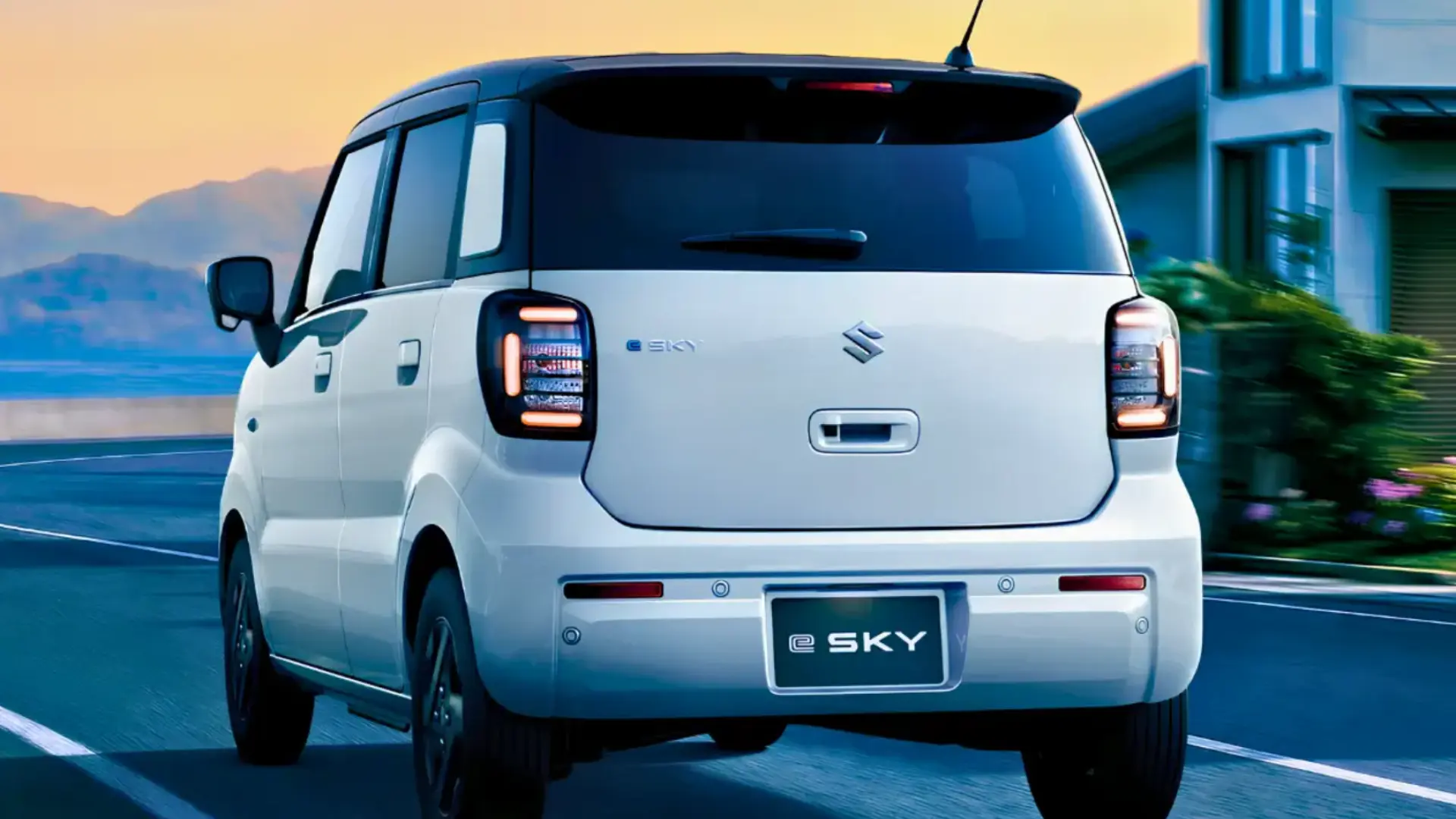
Suzuki has unveiled the e SKY, a compact electric car in Japan with a claimed reference range of 310 km. The model is expected to go on sale in Japan by March 2027.
Suzuki has not confirmed an India launch for the e SKY. However, its focus on a small size, low weight and everyday city driving makes it relevant to India's growing affordable EV market.
Suzuki's New Small EV
The e SKY is based on Suzuki's Vision e-Sky concept, first shown at the Japan Mobility Show in 2025. Suzuki designed the car for everyday use, including commuting, shopping and short trips.
The EV measures 3,395 mm long, 1,475 mm wide and 1,625 mm tall. Its compact size is aimed at making it easy to drive and park in cities.
Suzuki is targeting a 310 km reference range. The car also gets a 10.1-inch touchscreen, connected navigation and Vehicle-to-Load (V2L) functionality.
Japanese reports have cited a 26 kWh battery and 50 kW fast charging, but Suzuki's official announcement has focused primarily on the vehicle's range and development.
The approach is simple: instead of using a large battery to deliver long range, Suzuki is focusing on a smaller, lighter and more efficient car for everyday driving.
Why It Matters for India
The e SKY is designed for Japan's kei-car market, so it cannot simply be brought to India in its current form. India's regulations, safety requirements and customer preferences are different.
But the idea behind it could fit an important gap in India's EV market.
India already has a few compact electric cars. The MG Comet EV measures 2,974 mm in length and has a claimed range of 230 km. The Tata Tiago.ev offers up to 285 km of claimed range, while the Citroen e-C3 has a claimed range of 246 km.
| Model | Length | Claimed range |
|---|---|---|
| Suzuki e SKY | 3,395 mm | 310 km |
| MG Comet EV | 2,974 mm | 230 km |
| Tata Tiago.ev | ~3,770 mm | Up to 285 km |
| Citroen e-C3 | ~3,981 mm | 246 km |
The comparison shows that India's small EV market is still fairly limited. There is room between ultra-compact city cars and larger electric hatchbacks and SUVs.
A smaller battery and lighter vehicle could also help bring down energy use and, potentially, vehicle costs. But whether that translates into a lower purchase price will depend on battery costs, localisation and manufacturing scale.
Nano EV Conversation Returns
The debate over affordable small EVs has also resurfaced in India with recent comments about the Tata Nano.
Earlier this month, Ajay Jain, Head of India Design Studio at Tata Motors, spoke about the possibility of bringing back the Nano during an interaction with ABP Auto Live. He expressed interest in seeing the nameplate return, potentially as an electric car.
However, Tata Motors has not announced a Nano EV. There is no confirmed development programme, launch date, battery specification or price.
The comments are therefore best treated as an expression of interest, not a product announcement.
The Nano is still relevant to the discussion because its original proposition was built around affordable, compact personal mobility. An electric version, if it ever happens, would enter a very different market from the one the original Nano entered.
Can Small EVs Find More Buyers?
India's EV market has so far seen strong activity in larger electric cars, especially SUVs. Smaller EVs have a much smaller share of the passenger-car market.
For urban users who mainly drive short distances, a large battery may not always be necessary. A lighter vehicle with a smaller battery can use less energy and could potentially cost less to build.
But price alone will not decide the segment. Buyers will also consider safety, range, charging access, cabin space and overall running costs.
The e SKY itself is not confirmed for India, and its Japanese design would need changes to meet local requirements.
Still, Suzuki's latest EV highlights a direction worth watching: smaller batteries, lighter vehicles and practical city range instead of simply building bigger EVs.
For India's EV market, the question is whether manufacturers can turn that approach into small electric cars that are genuinely affordable for everyday buyers.

No comments yet